What Construction Management Software Buyers Want – And What It Means For Vendors
As an increasingly popular tool for enhancing construction workflows, the construction management software market is continuing to mature – and it is not always an easy field to navigate. While a handful of high-profile vendors have attracted significant publicity in recent months, buyer demands and core functionality requirements remain highly fragmented across users and regions. This presents a major growth opportunity for the 34 vendors assessed in the Verdantix Buyer’s Guide: Construction Management Software (CMS) (2025): to consolidate market share and establish themselves as dominant players at a regional or global scale.
Market momentum
Construction management software (CMS) is gaining strategic importance across the built environment as firms seek to boost productivity, reduce costs and improve operational resilience. This momentum is driven by mounting pressures: worsening labour shortages, fragmented data systems, tightening regulatory obligations and ambitious decarbonization goals.
The CMS market is evolving rapidly, with offerings ranging from plug-and-play tools for residential contractors to integrated lifecycle platforms tailored to megaprojects. Vendors are expanding their capabilities to meet diverse buyer needs, embedding AI, supporting modular construction workflows, enhancing interoperability and consolidating point solutions into unified platforms.
Buyers are looking for:
- Tools to offset shrinking workforces.
With over 40% of the US construction workforce expected to retire by 2031, buyers are turning to CMS to automate repetitive tasks and enable remote site monitoring. AI is already delivering value in scheduling and analytics, with 44% and 58% of capital project managers reporting significant or moderate benefits respectively, according to the 2024 Global Building Capital Project Managers Survey. - Improved data continuity and collaboration support.
Poor data governance contributes to rework costing over $88 billion across the globe annually. To address this issue, buyers want CMS platforms that unify fragmented systems and support seamless handover. With just 24% of firms boasting dedicated data transfer teams, connected environments have never been more important. - Audit-ready regulatory compliance.
Regional mandates such as Germany’s BIM Infrastructure requirement and California’s Caltrans Digital Delivery Initiative are pushing buyers to adopt CMS with digital audit trails and inspection record capabilities. This is a driving force for the majority of organizations: 65% of respondents to our global survey cite regulatory pressure as a significant factor in capital project strategy. - Sustainability and ESG alignment.
Buyers are placing greater emphasis on carbon management, with 74% of capital project decision-makers reporting ESG and decarbonization trends as strategic priorities. In fact, firm-wide sustainability goals rank higher in significance than regulatory compliance. To cater to this, CMS providers are increasingly embedding sustainability reporting and ESG KPI tracking into their platforms.
What this means for vendors:
- AI and automation must deliver tangible results.
AI features such as predictive capabilities and remote monitoring are in demand. Vendors must invest to keep pace with buyer demand. - Interoperability is non-negotiable.
CMS must integrate with ERP, EAM, BIM, productivity and BI tools. Open APIs and strong partner ecosystems are essential to de-risk deployment and support data continuity. For instance, Nemetschek’s GoCanvas platform offers over 1,000 third-party integrations. - Localized compliance capabilities are key.
Vendors must demonstrate regional expertise and the ability to meet country-specific data and reporting requirements. Buyers are evaluating future product roadmaps to ensure alignment with evolving regulations and mitigate legal liability. - Sustainability features are imperative.
CMS platforms must support embodied and operational carbon benchmarking, especially for firms with ambitious decarbonization targets. - Customer support drives retention.
Poor customer service is a leading cause of vendor churn, particularly for solutions like CMS that can be deployed on a project-by-project basis. Subcontractors and other users are often exposed to multiple platforms across different projects and quickly form preferences based on ease of use and support quality. Vendors must therefore offer responsive onboarding, training and post-deployment engagement. Platforms that support user-driven configurability and embed customer feedback into development cycles will gain long-term loyalty.
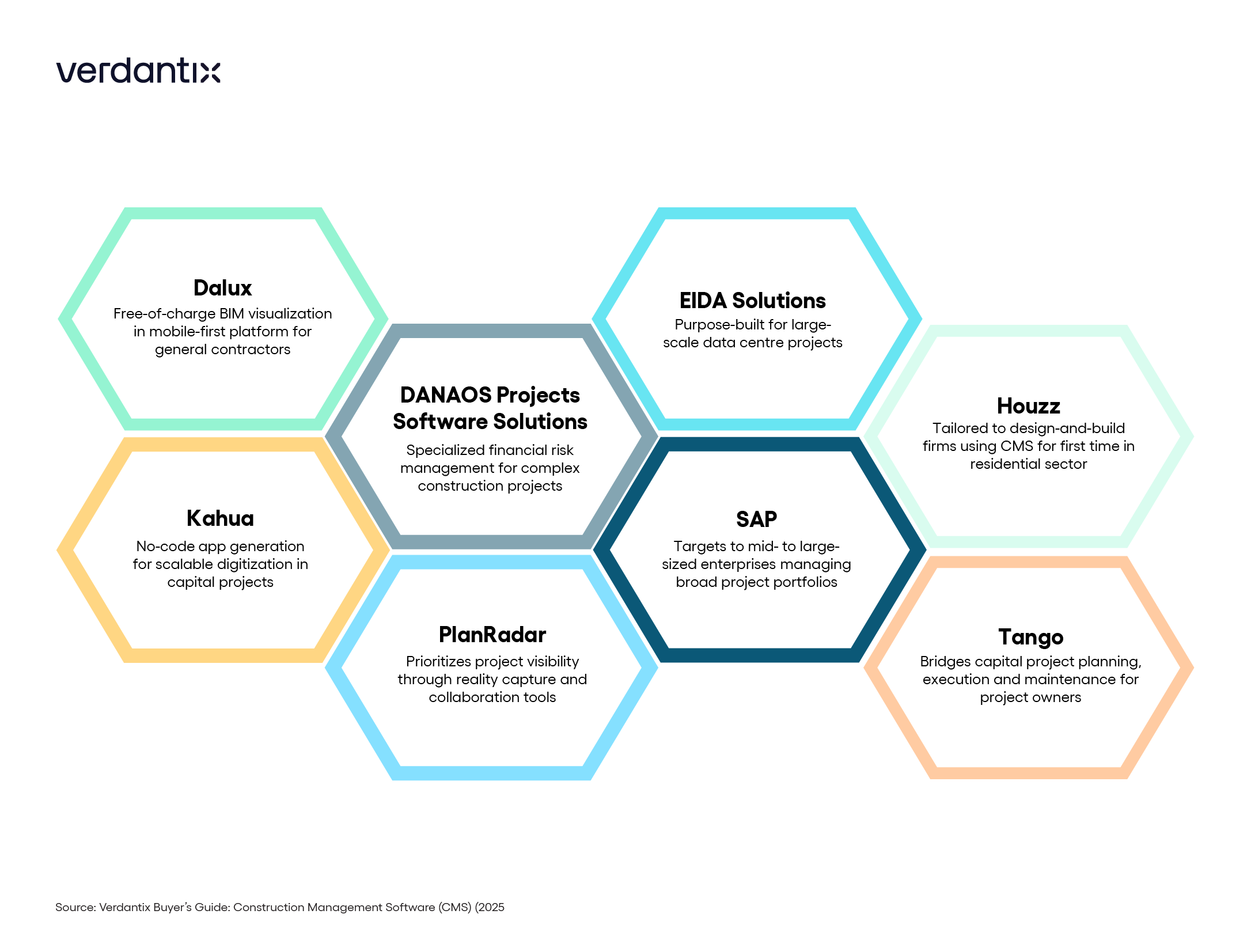
Beyond evaluating core functionality coverage, Verdantix highlighted the innovative ways vendors are responding to market signals:
About The Author

Sophie Planken-Bichler
Industry Analyst



.jpg?sfvrsn=c008f75f_1)