The Tariff Anniversary Nobody Is Celebrating
One year after the US import tariffs introduced on what President Trump dubbed “Liberation Day”, the impact across the industrial economy is becoming clear. What was framed as a policy intended to protect domestic manufacturing has instead forced many industrial firms to confront a new reality. Trade policy shocks can rapidly reshape cost structures, disrupt supply chains and expose weaknesses in how organizations manage operational risk.
For many industrial leaders, the experience feels familiar. The COVID-19 pandemic revealed how fragile globally optimized supply chains had become. In response, many firms invested in improved supplier visibility, diversified sourcing strategies and stronger contingency planning. These changes meant that organizations entered the tariff cycle better prepared than they might have been five years earlier. Even so, tariffs have acted as another major stress test. While the pandemic disrupted logistics and workforce availability, tariffs have directly altered the economics of sourcing and production.
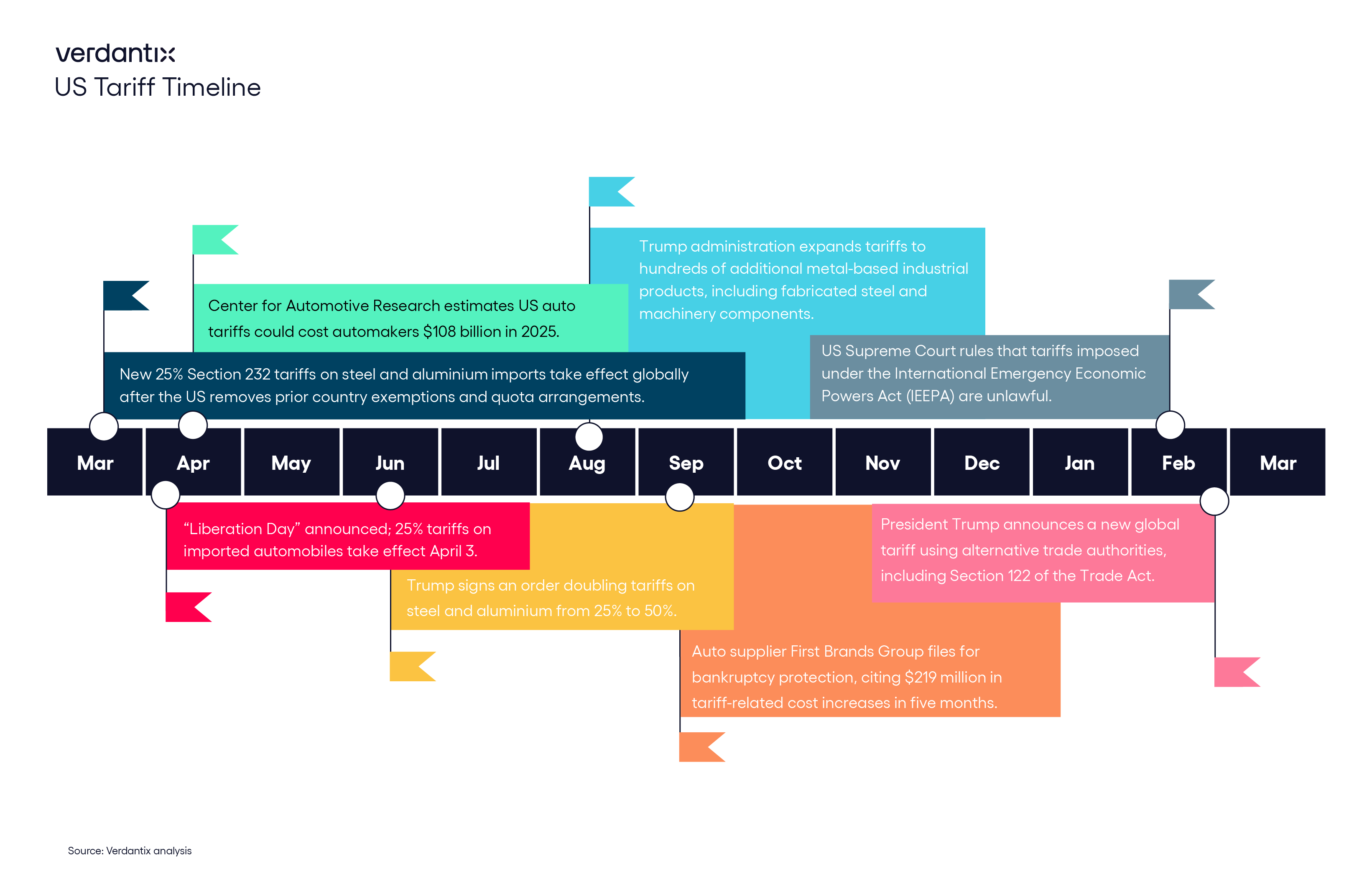
The most immediate effect has been a sharp increase in input costs across multiple industrial sectors (see below). Automotive, heavy equipment and industrial manufacturing have been particularly exposed because of their reliance on global component supply chains. Ford estimated that the 2025 tariffs would add roughly $2.5 billion in costs for the year, largely driven by vehicles and components imported from Mexico and China. To account for this, Ford raised prices on several Mexico-produced models – including the Maverick pickup truck and Bronco Sport SUV – as tariff costs began feeding into vehicle pricing.
In some cases, the financial consequences have been more severe. Auto parts manufacturer First Brands Group filed for bankruptcy protection in September 2025 with more than $10 billion in liabilities, sending shockwaves through the automotive supply chain. The organization told lenders that tariffs had imposed $219 million in additional costs in just five months, severely straining a business already carrying substantial debt. While tariffs were not the sole cause of the collapse, the episode illustrates how rising input costs can destabilize manufacturers operating on thin margins.
The policy of tariffs itself has also become a source of uncertainty. In February 2026, the US Supreme Court ruled that tariffs imposed under the International Emergency Economic Powers Act were unlawful, concluding the statute did not grant the President authority to impose tariffs without congressional authorization. Within hours of the ruling, the administration moved to maintain tariffs through alternative trade authorities including Section 122 of the Trade Act of 1974 and new Section 301 investigations.
Beyond the financial impacts, the past year has exposed deeper weaknesses in how industrial firms manage supply chain risk. Organizations that optimized production networks purely for efficiency often had limited visibility into their exposure to geopolitical disruption. When tariffs altered the economics of sourcing and manufacturing, many firms struggled to quickly evaluate alternative suppliers or production options.
This is where the concept of industrial agility becomes increasingly relevant. Industrial agility describes an organization’s ability to sense disruption early, analyse potential operational impacts and execute adjustments across sourcing, production and logistics. Firms that invested in supply chain visibility and operational flexibility following the COVID-19 pandemic, for example, have been better positioned to respond to the tariff shock.
One year after “Liberation Day”, the broader lesson for industrial leaders is becoming clear. Global manufacturing is entering an era where geopolitical decisions can rapidly reshape industrial economics. Firms that treat disruption as an occasional anomaly will continue to be caught off-guard. Those that build industrial agility into their operating model will be more prepared to navigate the next shock when it inevitably arrives.
About The Author

Josh Graessle
Senior Manager