Industrial Firms Are Entering The Age Of Agility
Industrial firms are becoming accustomed to operating in environments that change faster than their traditional planning processes were designed to handle. Supply chains shift unexpectedly, energy costs fluctuate, regulations evolve and customer demand patterns change with little warning. For many organizations, the question is no longer whether disruption will occur, but how quickly they can adapt when it does.
In this context, it is helpful to define a capability that enables firms to respond to volatility while maintaining performance: industrial agility. While the term is sometimes used interchangeably with resilience or operational flexibility, it describes something more specific. Industrial agility is the ability to anticipate variability, respond to it in a coordinated way and adjust operational execution before performance deteriorates.
A key distinction is that agility is not simply about moving faster. Speed alone can amplify disruption if actions are poorly coordinated. Instead, agility reflects the ability to make better decisions under changing conditions, and to translate those decisions into operational adjustments across production, maintenance, supply chains and engineering workflows.
One way to understand this capability is through a continuous decision cycle that connects planning, data and operational execution (see below).
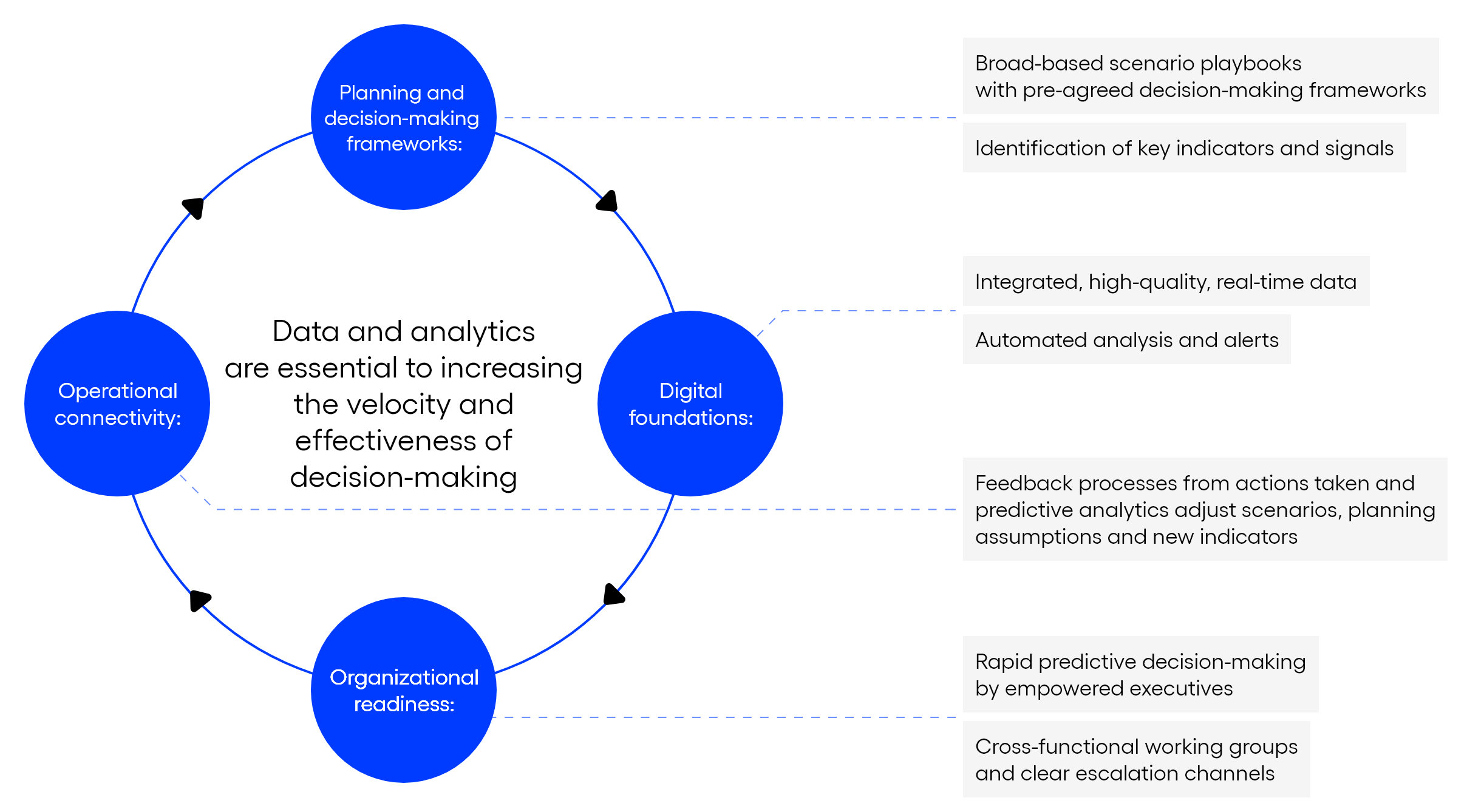
This framework helps illustrate that agility is not created by technology alone. It emerges when several elements reinforce one another. At the centre of this cycle is the ability to increase both the velocity and effectiveness of decision-making. When organizations can identify signals earlier, evaluate scenarios quickly and translate decisions into operational action, they are far better positioned to respond to volatility without sacrificing performance.
The cycle begins with planning and decision frameworks. Agile firms move beyond static forecasts and develop scenario-based playbooks that prepare them for multiple possible operating conditions. By identifying leading indicators and early signals of disruption, leadership teams can trigger predefined decision frameworks that help them respond more quickly when market or operational conditions shift.
These planning processes depend heavily on strong digital foundations. Industrial organizations generate enormous volumes of operational data, but that information is often fragmented across disconnected systems. Integrated digital platforms that bring together manufacturing, asset management, engineering and supply chain data provide a shared and reliable view of operational performance. With high-quality, real-time data and automated analytics, firms can detect emerging risks earlier and generate insights that support faster decision-making.
However, data and insight alone do not create agility. Firms must also develop the structures that allow decisions to be made quickly. Organizational readiness plays a critical role here. Agile firms increasingly rely on empowered leadership teams, cross-functional working groups and clear escalation channels that allow operational, engineering and supply chain leaders to align their responses when disruptions occur.
Finally, operational connectivity links decision-making directly to execution. Predictive analytics and scenario modelling can identify potential disruptions, but their value is limited if insights do not translate into operational changes. Industrial agility requires connected systems and workflows that allow decisions to trigger adjustments across production schedules, maintenance activities and supply allocations. The results of these actions then feed back into planning models, continuously improving future responses.
To find out more about industrial agility, check out the Verdantix Dislocation Index page.
About The Author

Josh Graessle
Senior Manager